

Introduction
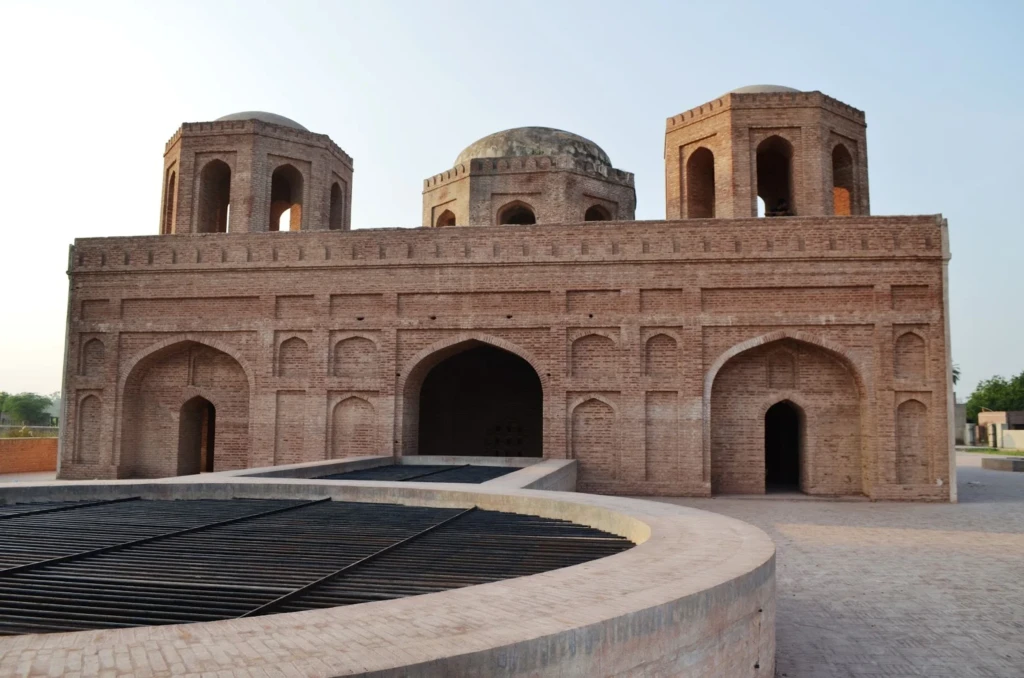
Jandial Temple is one of the most unique and mysterious archaeological sites in Pakistan. Located near the ancient city of Sirkap in the historic Taxila valley, the temple is renowned for its remarkable Greek-style architecture and unusual design. Unlike the Buddhist stupas and monasteries commonly found in Taxila, Jandial Temple reflects strong Hellenistic and possibly Zoroastrian influences, making it one of the most fascinating monuments of the Gandhara civilization.
The temple was first excavated by British archaeologist Sir John Marshall during the Archaeological Survey of India in 1912–1913. Historians consider it one of the finest examples of Greek-inspired architecture discovered in South Asia. Its Ionic columns, classical layout, and elevated structure continue to attract archaeologists, historians, travelers, and researchers from around the world.
Where is Jandial Temple Located?
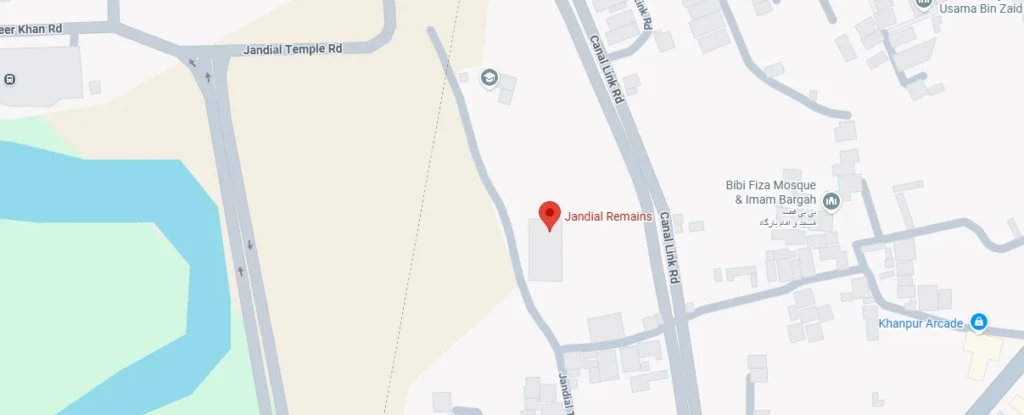
Jandial Temple is located in the northern region of the Taxila valley near Khanpur Road, approximately 1.5 kilometers north of Sirkap and close to the Taxila Museum.
The temple stands on an elevated artificial mound and overlooks parts of the ancient city ruins. Its strategic location suggests that it once served as an important religious and ceremonial center in ancient Taxila.
Visitors can easily reach the temple from Islamabad and Rawalpindi through the Grand Trunk Road.
History of Jandial Temple
Origins of the Temple
The Jandial Temple dates back to the 1st century BC or early 1st century AD during the Indo-Parthian period. Many historians believe that the temple was built under the rule of the Parthian king Gondophares, also known locally as Gendu Firoz.
Unlike most monuments in Taxila associated with Buddhism, Jandial Temple is widely believed to have been a Zoroastrian fire temple. This makes it an exceptionally rare structure in the region and highlights the religious diversity of ancient Taxila.
Greek Influence in Taxila
The architecture of the temple strongly reflects Hellenistic influence introduced after the campaigns of Alexander the Great in the region.
Following Alexander’s invasion, Greek artistic traditions spread across Gandhara and blended with local South Asian cultures. Jandial Temple is considered one of the clearest surviving examples of this cultural fusion.
Ancient accounts describe Taxila as a city that resembled Greek urban settlements in its planning and architecture.

Apollonius of Tyana and Historical References
Some historians believe that the Greek philosopher Apollonius of Tyana may have visited the temple during his travels across the Indian subcontinent.
Ancient descriptions mention a grand stone temple decorated with bronze plaques portraying scenes related to Alexander and King Porus. According to historical traditions, these plaques were placed inside the temple walls to commemorate bravery and military achievements.
Although the bronze plates are no longer present, archaeologists believe that further excavations may reveal additional historical artifacts buried beneath the ruins.
Architecture of Jandial Temple
Greek-Style Design
Jandial Temple is famous for its classical Greek architectural style. The structure closely resembles ancient Greek temples and features:
- Ionic columns
- Rectangular floor plan
- Symmetrical layout
- Elevated platform
- Stone masonry construction
The temple’s façade was constructed using limestone and kanjur stone, a porous sedimentary rock commonly used in Gandhara architecture.
Massive sandstone blocks were also used in the construction of pillars and supporting structures.
Semi-Classical Layout
The temple is categorized as semi-classical because its overall design combines Greek architectural planning with local and regional religious traditions.
Its layout includes:
- Naos (main shrine chamber)
- Pronaos (front hall)
- Opisthodomos (rear chamber)
Two Ionic columns positioned between anta walls create a typical Greek-style entrance.
The structure measured approximately 45 by 30 meters and originally stood on a platform nearly 40 feet above ground level.
Possible Zoroastrian Fire Temple
Some scholars believe the temple may have functioned as a Zoroastrian fire sanctuary rather than a Greek temple.
A strong internal wall and elevated platform located behind the main shrine resemble structures found in ancient fire temples of Persia and Central Asia.
Historians suggest that a sacred fire altar may once have existed inside the temple complex.
This theory explains why the temple differs significantly from nearby Buddhist monuments in Taxila.
Construction Techniques
The Ionic capitals found at Jandial Temple are considered simplified provincial adaptations of classical Greek designs.
Archaeologists observed:
- Carefully attached stone drums
- Precise masonry work
- Simple wall moldings
- Advanced stone construction techniques
These features suggest that the temple may have been built either directly by Greek craftsmen or under strong Greek artistic supervision.
The influence of Hellenistic culture remained strong in Gandhara for centuries after Alexander’s conquest.
Cultural and Religious Importance
Jandial Temple is historically important because it demonstrates:
- Greek influence in ancient Pakistan
- Religious diversity in Taxila
- Indo-Greek cultural interaction
- Possible Zoroastrian worship practices
- Advanced architectural planning
The temple also highlights the cosmopolitan nature of ancient Taxila, where Greek, Persian, Buddhist, Hindu, and Central Asian traditions interacted with one another.

Things to See at Jandial Temple
Visitors exploring the site can observe:
- Ancient Ionic columns
- Elevated stone platform
- Main shrine area
- Greek-inspired architectural remains
- Ancient stairways and corridors
- Panoramic views of Taxila valley
The peaceful surroundings and historical atmosphere make the temple a fascinating destination for history enthusiasts and photographers.
How to Reach Jandial Temple
Jandial Temple is located in the historic Taxila valley near Khanpur Road, approximately 40 kilometers from Islamabad and around 1.5 kilometers north of Sirkap. The temple can easily be reached through the Grand Trunk (GT) Road, making it one of the accessible archaeological attractions in Taxila. Its location near the Taxila Museum and other ancient ruins allows visitors to explore multiple historical sites during a single trip.
Travelers can visit Jandial Temple by private vehicle, taxi, ride-hailing services, or public transport operating between Islamabad, Rawalpindi, and Taxila. Local buses and passenger vans regularly travel along GT Road, while rickshaws and local taxis are available from Taxila city to the temple site.
Nearby Attractions
Tourists visiting Jandial Temple can also explore:
- Sirkap
- Dharmarajika Stupa
- Taxila Museum
- Bhir Mound
- Other Taxila archaeological ruins
For a broader overview, read our complete guide on Taxila Pakistan.
Best Time to Visit
The best time to visit Jandial Temple is during:
- Spring (February to April)
- Autumn (September to November)
Pleasant weather during these seasons makes exploring the ruins more comfortable.
Travel Tips for Visitors
- Wear comfortable walking shoes
- Carry water during warmer months
- Visit during daylight hours
- Respect archaeological monuments
- Hire a guide for historical insights
Frequently Asked Questions (FAQs)
What is Jandial Temple famous for?
Jandial Temple is famous for its Greek-style architecture and possible connection to Zoroastrian worship practices.
Where is Jandial Temple located?
The temple is located near Sirkap in Taxila, Punjab, Pakistan.
Who built Jandial Temple?
Historians believe the temple was built during the Indo-Parthian period under King Gondophares.
Why is Jandial Temple unique?
It is one of the rare examples of Hellenistic architecture in South Asia and differs greatly from nearby Buddhist monuments.
Can tourists visit Jandial Temple?
Yes, the site is open to tourists and forms part of the Taxila archaeological complex.
Conclusion
Jandial Temple remains one of the most mysterious and architecturally unique monuments in Pakistan. Its Greek-inspired design, possible Zoroastrian origins, and historical connection to the Gandhara civilization make it an extraordinary archaeological treasure.
Today, the temple continues to attract travelers, historians, and researchers interested in exploring the multicultural heritage of ancient Taxila and the fascinating blend of Greek and South Asian civilizations.

62 Comments
Olivewidly
маркетплейс аккаунтов маркетплейс аккаунтов
Peterdaw
магазин аккаунтов заработок на аккаунтах
RichardTen
маркетплейс аккаунтов площадка для продажи аккаунтов
JamesCledo
магазин аккаунтов купить аккаунт
Olivewidly
маркетплейс аккаунтов соцсетей продать аккаунт
Bryantbeini
площадка для продажи аккаунтов https://kupit-akkaunt-top.ru/
RichardTen
покупка аккаунтов https://pokupka-akkauntov-online.ru
DavidNaisk
Account Exchange Service Ready-Made Accounts for Sale
JasonRah
Sell Pre-made Account Social media account marketplace
MichaelMibra
Accounts marketplace Account market
WalterFlact
Find Accounts for Sale Account marketplace
JaredSoals
Website for Buying Accounts Account Market
BrianCoaps
Profitable Account Sales Secure Account Purchasing Platform
Ronaldhex
Secure Account Sales Account market
ThomasGat
Account Trading Service Sell Account
BruceCUBOW
Accounts for Sale Account Exchange Service
Williamsep
Buy and Sell Accounts Account Market
Ronaldhex
Purchase Ready-Made Accounts Purchase Ready-Made Accounts
BrandonGuede
account trading service account selling service
EdmundDeats
account trading platform social media account marketplace
RomeoGaH
secure account purchasing platform account buying service
DonaldSab
account selling platform profitable account sales
Keithvet
marketplace for ready-made accounts account store
RobertGeasy
account sale ready-made accounts for sale
Hectorwem
account market account market
CarlosMar
buy and sell accounts website for buying accounts
Richardusero
account trading service account market
Carlosjeape
buy accounts secure account purchasing platform
Stephentraky
account selling service account selling service
Stevenslace
website for selling accounts online account store
Clydedoulp
account buying platform profitable account sales
JohnnyDot
social media account marketplace secure account purchasing platform
ThomasPouff
social media account marketplace account acquisition
PhilipDib
secure account sales https://buy-social-accounts.org/
RandalOxilt
online account store website for selling accounts
RichardMouse
buy account accounts marketplace
Zacharymax
sell pre-made account marketplace for ready-made accounts
Kevinjoipt
online account store account acquisition
Raymondweiff
account buying service accounts marketplace
Thomasnussy
account trading platform buy account
NathanKiz
social media account marketplace account marketplace
BruceObere
buy pre-made account account catalog
Danielnot
account exchange profitable account sales
Geraldmox
account exchange account acquisition
Jasonvon
account buying service accounts-buy-now.org
ThomasBeada
find accounts for sale verified accounts for sale
accounts-offer.org_Cousy
account acquisition https://accounts-offer.org
accounts-marketplace.xyz_Cousy
secure account sales accounts market
buy-best-accounts.org_Cousy
account exchange service https://buy-best-accounts.org
social-accounts-marketplaces.live_Cousy
marketplace for ready-made accounts buy accounts
accounts-marketplace.live_Cousy
gaming account marketplace https://accounts-marketplace.live
social-accounts-marketplace.xyz_Cousy
ready-made accounts for sale https://social-accounts-marketplace.xyz
buy-accounts.space_Cousy
gaming account marketplace https://buy-accounts.space
buy-accounts-shop.pro_Cousy
buy account https://buy-accounts-shop.pro/
social-accounts-marketplace.live_Cousy
account acquisition https://social-accounts-marketplace.live/
buy-accounts.live_Cousy
marketplace for ready-made accounts https://buy-accounts.live/
accounts-marketplace.online_Cousy
account trading platform https://accounts-marketplace.online/
accounts-marketplace-best.pro_Cousy
website for buying accounts accounts-marketplace-best.pro
akkaunty-na-prodazhu.pro_Cousy
биржа аккаунтов akkaunty-na-prodazhu.pro
rynok-akkauntov.top_Cousy
покупка аккаунтов rynok-akkauntov.top
kupit-akkaunt.xyz_Cousy
маркетплейс аккаунтов https://kupit-akkaunt.xyz/
akkaunt-magazin.online_Cousy
маркетплейс аккаунтов магазины аккаунтов